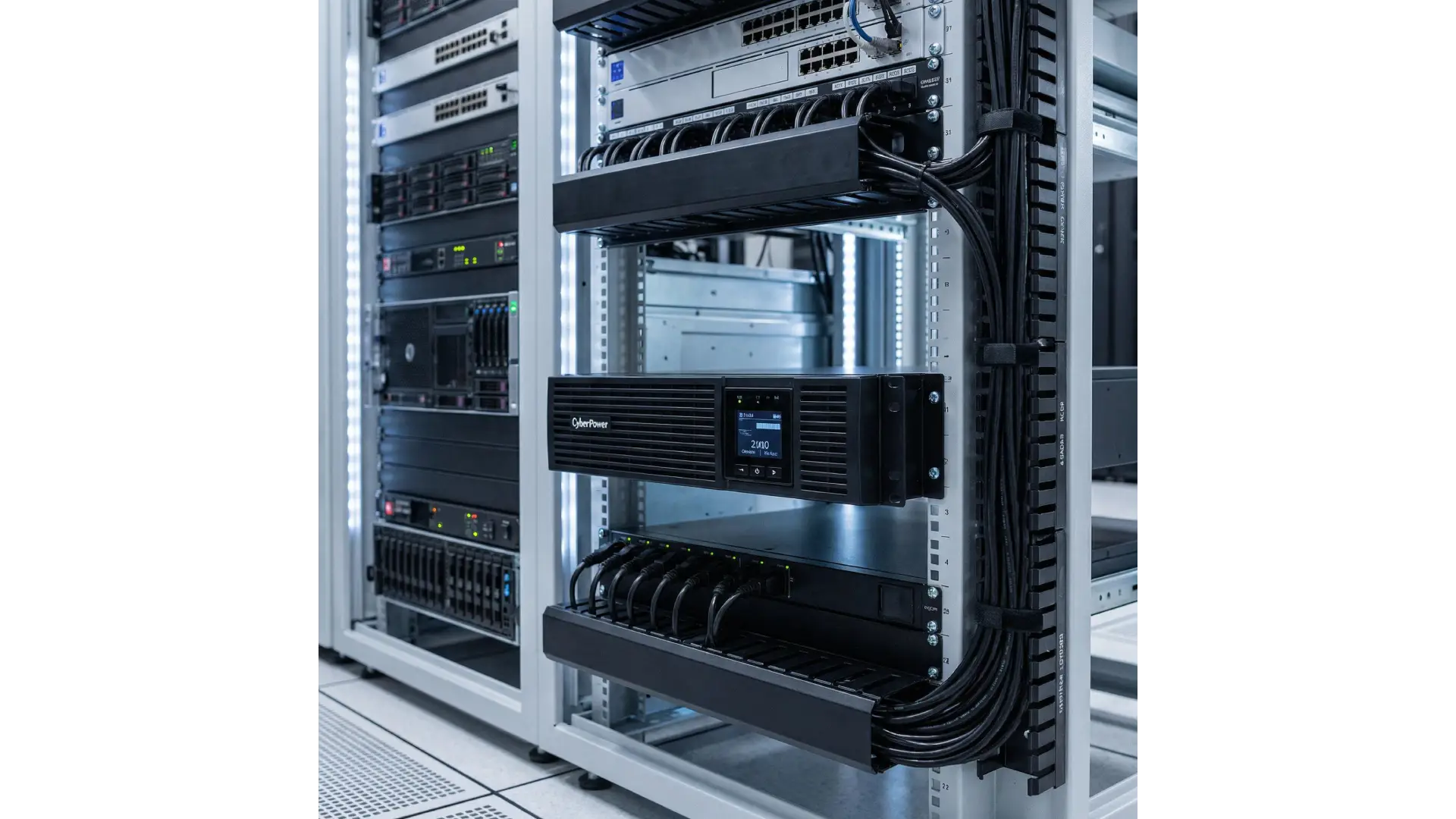
When I started exploring backup power solutions, I realized that power outages can be more than a minor inconvenience, especially for businesses, data centers, medical facilities, security systems, and industrial operations where even a short interruption can cause downtime, data loss, or equipment problems. That’s why I became interested in a 24 hour uninterruptable power supply, which is designed to keep critical equipment running during extended outages.
Unlike a standard UPS that may only provide a few minutes of backup, a 24 hour uninterruptable power supply can use larger battery systems, external battery cabinets, lithium-ion or lead-acid batteries, and load management to provide significantly longer runtime. However, achieving 24 hours of backup depends on factors such as power consumption, battery capacity, UPS efficiency, battery condition, and the overall system design.
What Is a 24 hour uninterruptable power supply?
A 24 hour uninterruptable power supply is a UPS configuration designed to keep connected equipment operating for an extended period, potentially up to 24 hours, when normal utility power is unavailable.
The phrase “24 hour” describes the desired runtime rather than a standard UPS category or a specific product size.
A typical UPS contains batteries that provide enough energy to keep equipment running temporarily during a power interruption. Eaton explains that many conventional UPS systems are designed for roughly 10 to 15 minutes of runtime using their internal batteries, while external battery modules can extend runtime to several hours depending on the load and configuration.
A system designed for 24 hours requires substantially more stored energy.
It may include:
- A UPS power module
- Internal batteries
- External battery cabinets
- Multiple battery strings
- Battery management systems
- Remote monitoring
- Automatic load shedding
- Generator integration
- Maintenance bypass equipment
- Power distribution equipment
The exact architecture depends heavily on how much power the equipment consumes. This is an important distinction because adding batteries increases runtime, but it does not necessarily increase the maximum amount of power the UPS can deliver. For example, a UPS rated for 3,000 watts remains a 3,000-watt UPS even if additional battery cabinets allow it to operate for many more hours.

Why Would You Need 24 Hours of Backup Power?
Most people don't need 24 hours of UPS runtime.
If you're protecting a desktop computer, router, monitor, or small network device, a few minutes may be enough to save your work or shut the equipment down safely.
The situation changes when the equipment is expected to remain operational throughout a prolonged outage. A 24 hour uninterruptable power supply may be considered for applications such as:
- Data centers
Servers, network switches, storage systems, security equipment, and communications infrastructure may be considered mission-critical.
A UPS provides immediate protection against utility interruptions while allowing administrators time to restore normal power, shut systems down safely, or transition to another power source.
- Telecommunications
Telecommunications infrastructure often needs to remain available even when commercial power is unavailable.
Extended battery systems can provide additional time before equipment needs to shut down or another power source takes over.
- Security systems
Surveillance cameras, access-control systems, alarms, recording equipment, and security networks can lose their effectiveness if their backup batteries run out during an extended outage.
- Healthcare facilities
Certain medical and support systems require extremely reliable electrical infrastructure. UPS systems may form part of a larger emergency-power architecture.
- Industrial facilities
Manufacturing and industrial control systems can be particularly sensitive to unexpected shutdowns. A sudden interruption can stop production, interrupt automated processes, or require lengthy restart procedures.
- Remote installations
A remote communications site, monitoring station, or network installation may be difficult to access during an outage.
How Does a 24 hour uninterruptable power supply Work?

The basic operating principle is relatively simple. Under normal conditions, utility electricity powers the connected equipment while the UPS maintains its batteries at the appropriate charge level.
When the incoming power fails or moves outside acceptable operating limits, the UPS uses stored DC energy from its batteries and converts it into AC power for the connected equipment. The difference with a 24 hour uninterruptable power supply is the scale of the energy-storage system.
Instead of relying exclusively on a small internal battery pack, the UPS may connect to external battery modules or cabinets. For example, Vertiv offers UPS systems with scalable external battery configurations specifically intended to extend runtime. Eaton similarly offers UPS systems with external battery modules designed to increase runtime.
This modular approach is useful because the UPS doesn't necessarily have to change when the required runtime increases. Additional battery capacity can be added within the limits of the particular UPS system. However, the manufacturer's specifications are critical. Not every UPS supports external batteries, and supported battery configurations vary considerably between models.
The Most Important Question: How Much Power Does Your Equipment Use?
Before choosing a 24 hour uninterruptable power supply, determine the actual power consumption of the equipment you intend to protect.
This is where many UPS calculations go wrong.
People often start by asking, “What size UPS do I need?” A better starting question is:
“How many watts does my critical equipment actually consume?”
Imagine a small server room containing:
- Server: 400 watts
- Network equipment: 150 watts
- Storage equipment: 200 watts
- Security equipment: 100 watts
- Communications equipment: 150 watts
The total load would be:
400 + 150 + 200 + 100 + 150 = 1,000 watts
To operate that load for 24 hours, the theoretical energy requirement would be:
1,000 watts × 24 hours = 24,000 watt-hours
That equals:
24 kWh
However, 24 kWh should not automatically be interpreted as the exact battery capacity you need.
Real-world systems have losses and operating limitations.
You need to account for:
- UPS efficiency
- Inverter losses
- Battery discharge characteristics
- Battery aging
- Temperature
- Depth of discharge
- Charging losses
- Reserve capacity
- Future load growth
The actual battery bank may therefore need substantially more nominal capacity than the basic calculation suggests.

Watts vs VA: What's the Difference?
Another important consideration when selecting a 24 hour uninterruptable power supply is the difference between watts and volt-amperes, or VA.
Watts represent real power consumption. VA represents apparent power.
A UPS needs to be capable of handling the electrical characteristics of the connected equipment, not just its nominal wattage.
Modern UPS systems often provide a power-factor rating that makes the relationship between VA and watts more straightforward.
For example, Vertiv's Edge UPS family offers a power factor of 0.9, while some higher-capacity UPS systems offer a power factor of 1.0.
When sizing a UPS, don't simply match its rated capacity to your measured load.
Some additional capacity is generally desirable.
That gives you room for:
- Startup loads
- Load fluctuations
- Additional equipment
- Future expansion
- Unexpected changes in operating conditions
The goal is to avoid running a UPS continuously at its maximum rated capacity.
Battery Technology for a 24 hour uninterruptable power supply
Battery technology plays a major role in long-duration backup systems.
The two technologies you're most likely to encounter are lead-acid and lithium-ion.
1. Lead-acid batteries
Valve-regulated lead-acid, commonly called VRLA, has been widely used in UPS applications for many years.
There are several reasons for this popularity:
- Established technology
- Broad availability
- Familiar maintenance procedures
- Predictable performance
- Compatibility with many UPS systems
The disadvantages become more noticeable as the required energy storage increases.
Large lead-acid battery banks can occupy considerable space and add substantial weight to an installation.
They also require appropriate environmental management and eventual replacement.
2. Lithium-ion batteries
Lithium-ion technology has become increasingly popular in UPS applications.
Its major advantages can include:
- Higher energy density
- Lower weight
- Smaller footprint
- Longer service life
- Faster recharge
- More discharge cycles
- Reduced maintenance requirements
Eaton highlights the compact footprint, energy density, longer life, and charging characteristics of lithium-ion UPS batteries.
Vertiv similarly states that certain lithium-ion UPS batteries can provide significantly longer life and more discharge cycles than traditional VRLA batteries.
For a 24 hour uninterruptable power supply, the physical size of the battery bank can become a major consideration.
If the system needs hundreds of kilowatt-hours of stored energy, reducing battery weight and footprint can have a significant effect on the overall installation.
That doesn't automatically make lithium-ion the right choice, though.
Total cost, safety requirements, installation standards, temperature, maintenance expectations, and the specific UPS manufacturer's compatibility requirements all need to be considered.

Why Temperature Matters
Battery performance isn't independent of the environment. Temperature can affect both battery performance and service life. This becomes particularly important with a 24 hour uninterruptable power supply because the battery system is likely to be much larger than that found in a standard office UPS.
A battery room or equipment area that becomes excessively hot can create unfavorable operating conditions. Proper ventilation, cooling, environmental monitoring, and installation practices should therefore be considered part of the UPS design rather than afterthoughts. The manufacturer's environmental specifications should always be followed.
How Battery Aging Affects 24-Hour Runtime
One of the biggest mistakes when planning a 24 hour uninterruptable power supply is assuming that the battery will provide exactly the same performance throughout its entire service life.
It won't.
Battery capacity gradually changes as batteries age.
That means a system that was capable of supporting a particular load for 24 hours when new may provide less runtime several years later.
This is why battery monitoring and maintenance are important.
A proper maintenance strategy may include:
- Regular inspections
- Battery voltage checks
- Temperature monitoring
- Battery health monitoring
- UPS self-tests
- Runtime testing
- Connection inspections
- Replacement planning
For mission-critical systems, battery replacement should be planned before batteries become unreliable rather than waiting for an outage to reveal a problem.
External Battery Cabinets and Extended Runtime
For many applications, external battery cabinets are the most practical way to build a 24 hour uninterruptable power supply.
Instead of making the UPS itself physically enormous, the system uses a UPS power module connected to additional battery cabinets.
This creates a scalable architecture. Vertiv, for example, offers UPS families that support multiple external battery cabinets. Its Edge UPS family can support up to six external battery cabinets on selected models.
Its Liebert GXE 6-10 kVA systems can also be configured with multiple external battery cabinets for extended runtime. Eaton likewise offers UPS products that support external battery modules for extended runtime.
The advantage is flexibility. You can design the system around the required runtime rather than automatically buying an oversized UPS.
However, there are limits. The UPS manufacturer specifies how many battery cabinets can be connected, what voltage configuration is required, and which batteries are compatible.
Those specifications should never be ignored.
Features to Look for in a 24 hour uninterruptable power supply
When choosing a 24 hour uninterruptable power supply, look beyond the VA rating and consider the following key features:
- External battery support: Make sure the UPS can support the battery configuration needed to achieve your desired runtime.
- Runtime monitoring: Choose a system that provides accurate information about battery status, current load, and estimated remaining runtime.
- Remote management: Network monitoring allows you to monitor and manage the UPS remotely, which is especially useful for unattended installations.
- Load shedding: This feature helps prioritize critical equipment by automatically reducing power to less important loads during an extended outage.
- Hot-swappable batteries: When available, hot-swappable batteries make maintenance and replacement easier while helping minimize service interruptions.
- Maintenance bypass: A maintenance bypass allows technicians to service the UPS without unnecessarily interrupting power to connected equipment.
- Pure sine-wave output: A clean sine-wave output can provide better compatibility and stable power for sensitive electronic equipment.
- Scalability: If your power requirements may increase over time, choose a UPS that can accommodate additional batteries or higher loads as your needs grow.
Frequently Asked Questions
Can any UPS provide 24 hours of backup?
No. A standard UPS typically does not contain enough battery capacity to provide 24 hours of runtime. A long-duration configuration usually requires external battery modules, large battery banks, or another power source.
How much battery capacity is required for 24 hours?
It depends on the load.
A 100-watt load theoretically consumes 2.4 kWh over 24 hours.
A 1,000-watt load theoretically consumes 24 kWh.
A 10 kW load theoretically consumes 240 kWh.
Actual battery requirements will be higher after accounting for system losses, reserve capacity, battery characteristics, aging, and environmental conditions.
Does a larger UPS provide longer runtime?
Not necessarily.
UPS output capacity and battery energy are different things. A higher-capacity UPS can power a larger load, but runtime still depends on the available battery energy.
Is lithium-ion better for a 24 hour uninterruptable power supply?
Lithium-ion can offer advantages such as greater energy density, reduced weight, longer service life, and faster charging. However, the best battery technology depends on the application, budget, installation environment, safety requirements, and compatible UPS equipment.
Can I add external batteries to any UPS?
No.
The UPS must specifically support external batteries, and the batteries must be compatible with the UPS's voltage and electrical specifications.
Always follow the manufacturer's documentation.
Is a generator better than a 24 hour uninterruptable power supply?
They solve different problems.
A UPS provides immediate power continuity and protects equipment from the transition between power sources.
A generator is generally better suited to supplying power over much longer periods.
For many critical applications, using both technologies together is the more effective approach.
Conclusion
After looking deeper into 24 hour uninterruptable power supply systems, the biggest thing I learned is that achieving 24 hours of backup isn't simply a matter of buying a bigger UPS. It comes down to understanding the actual power requirements of the equipment, calculating how much stored energy is needed, and designing a system that accounts for efficiency losses, battery aging, temperature, and future growth.
For smaller loads, extended battery capacity may make 24-hour operation practical, while larger installations may be better served by combining a UPS with a generator or another long-duration power source. Ultimately, I would approach a 24-hour UPS as a complete backup-power system rather than a single piece of equipment, with the UPS providing immediate continuity and the batteries or secondary power source providing the endurance needed to keep critical equipment operating through a prolonged outage.
Source
https://www.energy.gov/sites/default/files/2022-12/ups-tp-nopr.pdf
continue reading
Related Posts

When I started looking into backup power options for smaller